Revisiting the original Roomba and its simple architecture
A couple of weeks ago, iRobot announced bankruptcy. The pathbreaking Boston-area company that makes the Roomba will now be owned by a Chinese consumer-goods manufacturer. People argue about who is to ...
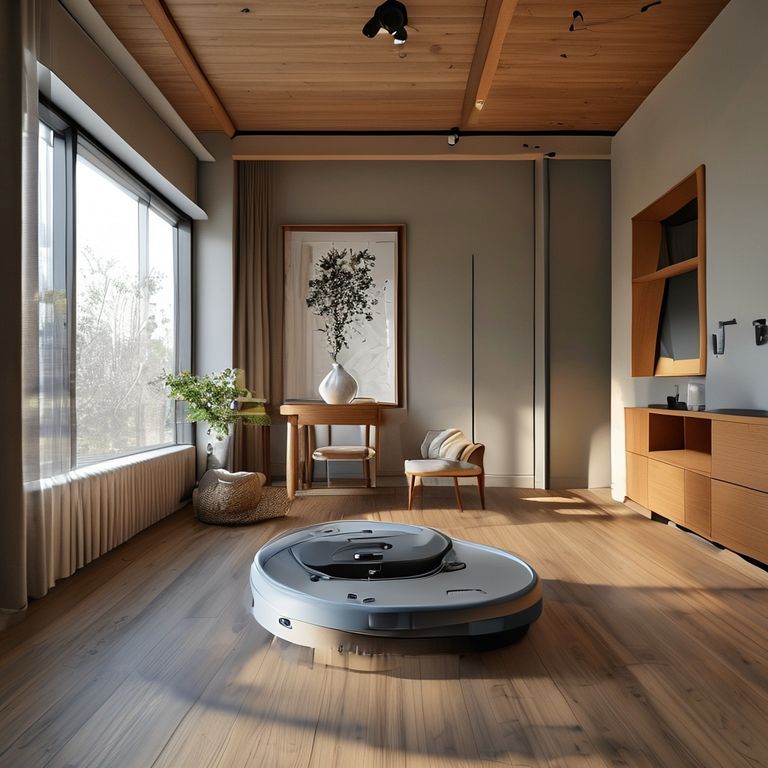
A couple of weeks ago, iRobot announced bankruptcy. The pathbreaking
Boston-area company that makes the Roomba will now be owned by a
Chinese consumer-goods manufacturer.
People argue about who is to blame for the failure of iRobot: Was it
poor management decisions? Government overreach in preventing
mergers? An inability to innovate? The inevitable race to the bottom
of any commodity consumer good?
Regardless of the reasons, I am sad about one thing: that robot
developers are missing what made the original Roomba
successful.
I will try to explain what made the design of the original Roomba
truly innovative, and what lessons we should take from it.
The Original Roomba
Introduced in 2002, the Roomba was the first successful consumer robot
for the home.
Cheap, off-the-shelf components helped price this original Roomba at
two hundred dollars so that people who needed a home vacuum could
consider buying it. It worked well enough that iRobot eventually sold
over forty million of them.
Completely autonomous, the Roomba only needed to be switched on. It
would run all over the floor, noisily brushing and vacuuming. When it
was done, you emptied its dirt chamber and plugged it in to recharge.
It had its limitations--- for example, it couldn't move furniture,
confine itself to one area, or deal with carpet strings or wet
messes. Its vacuum was anemic. But within these limitations, it could
maintain the floor at an everyday level of cleanliness.
This original Roomba was much simpler and more elegant than today's
mobile vacuum cleaning robots, including iRobot's present models and
many other competing products. In fact, its internal design was
fundamentally different from most other robots.
Greater than the sum
Normally, industrial robots are made robust and safe by using
high-quality, expensive parts that can execute programmed motions
precisely, reliably, and repeatedly. The robots are then deployed into
a carefully-designed, predictable environment, with safety systems
built around them. As long as they don't encounter surprises, their
programs continue to work smoothly. If something goes wrong, the
safety systems stop them for engineers to debug them.
But as a consumer robot built for unstructured home environments, the
Roomba took a radically different approach. Its software was written
in such a way that the robot could run as reliably as possible given
unreliable parts and an unpredictable environment.
The Roomba didn't have enough memory to remember a map of the room.
Instead of building a map, it used clever tricks to cover the
available floor region, albeit inefficiently. If it encountered an
obstacle, the robot could try backing up, turning, and moving to a
different location. If a rotating brush failed, the Roomba might not
be able to clean the floor as well as before, but it could at least
keep running and do as well as it could using the remaining brush and
the vacuum. The product was better than the sum of its parts.
From lab to stores
The secret to the Roomba's success was in its software. It was built
using an unconventional approach originally invented by Professor
Rodney Brooks in the 1980s at the MIT AI Lab. One of the researchers
who spent time with Rod Brooks's mobile robot group, Joe Jones, was
not actually part of the group, but someone deeply interested in this
approach to building robots. Brooks had built a software library, a
"behavior language," that enabled his students to program robots using
this approach. Jones was one of the few people who actually used the
behavior language.
Rodney Brooks co-founded iRobot, and Joe Jones joined the company as
an engineer. They made money by building custom robots, eventually
landing military contracts for remote-controlled PackBots. Ten years
later, when the company had enough money, Joe pushed the company to
develop a home vacuum cleaner, and this became the Roomba.
Behavior-based robotics
At MIT, Rodney Brooks's work in the mobile robot group was motivated
by a well-known paradox: computer programs can do many so-called
higher-level thinking tasks like numerical calculations, physics
simulations, theorem proving, and playing chess, but they fail at many
real-world tasks that seem simpler, like crawling out of a pit, that
even so-called low-level animals like insects can perform with ease.
Clearly, living things over the millenia have evolved basic survival
skills that are important in the real world. Something was missing in
the computer science approach to building robots. Brooks was
proposing an alternative approach that would at least demonstrate
insect-like abilities in the real world.
Robots sense their world using cameras, sonar, and other sensors, and
they act on the world via motors or other actuators. The conventional
approach to building an autonomous robot was to use sensors to gather
information about the world, build a model of the world using this
information, think about possible actions and their effects on this
model to form a plan, and then finally execute the plan on the real
world by commanding the actuators to do things.
But this method failed to deal with a changing, unpredictable world
that is sensed using unreliable sensors.
Instead, Brooks advocated building very simple programs that
continuously gather sensor data and directly drive the actuators. Each
program would achieve a single, simple goal. For example, imagine a
robot with two "eyes" consisting of simple photoreceptor cells that
can measure how much light falls on them. Such a robot could be made
to move toward a light source by always turning it to the left if the
left eye sees a brighter light, and vice versa. In software, this
could be done by driving each wheel in proportion to the difference
between the brightness perceived by the two eyes. This light-seeking
program would be an example of a basic ability. Then, using Brooks's
proposed software architecture, the programmer could compose several
such different basic abilities, called "behaviors," to achieve
higher-level goals.
Individual behaviors can be developed independently and added to the
robot. Some behaviors are analogous to the fundamental survival skills
developed by organisms early in evolution. These skills remain
available while more skills are developed. The trick is in picking the
right skills to use depending on the circumstances. For example, if a
Roomba discovers that it is standing at the edge of a staircase, then
it should stop cleaning and back up, trying a different direction.
Survival is a higher priority than cleaning.
Lessons
The Roomba showed that behavior-based robotics can be a practical
approach to developing autonomous robots that are actually useful and
fit for purpose.
The approach is not without its challenges. It can be very difficult
to figure out how exactly the different behaviors can be reconciled in
a robot. The complex interplay between them can make the robot very
hard to debug. Building robots is hard. Behavior-based robotics
doesn't solve all the problems building robots, but it does show how
certain very significant limitations can be addressed.
It's not clear whether robotic vacuums have kept the simplicity of
this approach. They don't seem to have. Today's Roombas and
competitors sport a great many features: cameras, network connections,
phone apps, maps built using visual simultaneous localization and
mapping (vSLAM), and so on. For the purposes of cleaning a floor, not
all these features count as innovations. Some might be necessary
(longer-lived batteries and a more powerful vacuum), but others might
be unnecessary dead weight.
In the heat of retail competition and the pursuit of growth, it can be
hard to keep your eye on the ball. When trading off advantages and
costs, you have to remain true to your architecture. The simplicity of
the original Roomba was a virtue.