Circuit Artist v1.1: Advanced Simulation Engine, Layered Design, and Expanded Gameplay Mechanics
The latest release of Circuit Artist introduces a variable‐delay event‑driven simulation based on Elmore delay calculations, realistic fan‑out effects, and pixel‑mapped propagation visualization. Players now enjoy multi‑layer schematic editing, a paced learning campaign, and inventory‑style blueprint management, all while gaining deeper insight into timing and energy efficiency.
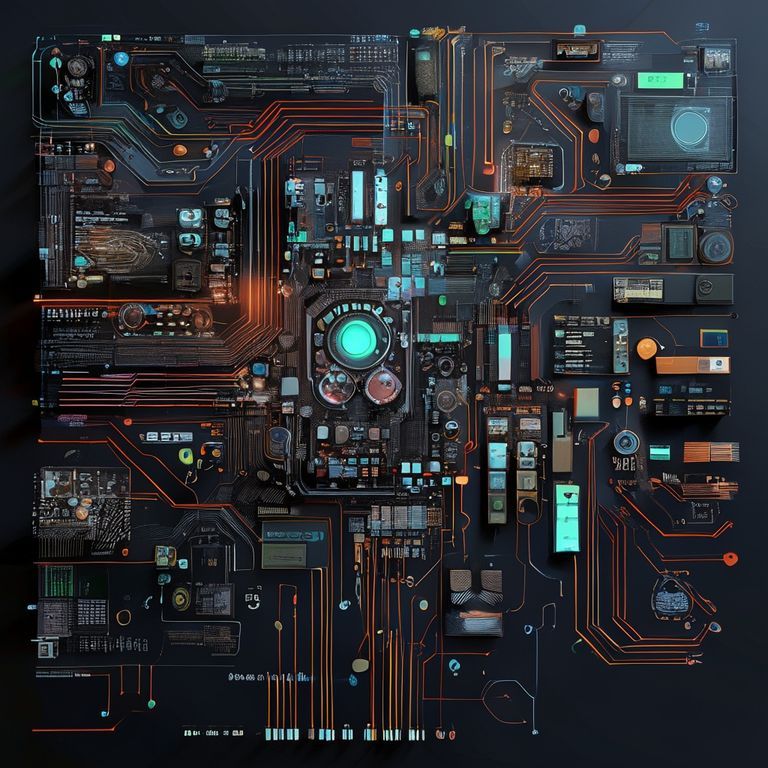
Circuit Artist, the open‑source digital logic circuit drawing game, has received a substantial update in version 1.1. The core of the new release is a sophisticated simulation engine that models signal propagation with variable delay, accounting for wire topology, Elmore delay on tree structures, and fan‑out on NAND gates. The result is a more accurate timing model that gives players a realistic feel for how actual circuits behave.
The simulation’s delay values are rendered as a pixel‑based propagation map; as signals travel along wires they are highlighted with a subtle glow, allowing designers to see the dynamic wavefront even in complex paths. Real‑time rendering is facilitated by simple shaders, keeping performance high while the simulation remains fully interactive.
A delta‑based framework now permits pausing, stepping forward, and stepping backward through simulation time. This is particularly useful for diagnosing problems in cyclic or feedback‑driven circuits, where observers can examine state changes at each tick.
Layered schematic design has been expanded to three layers, mimicking photo‑resolution software. Wires on upper layers propagate faster and can cross to adjacent layers, adding spatial and temporal nuance. NAND gates, however, are confined to the bottom layer to preserve circuit semantics.
To support newcomers, a campaign system has been introduced, offering a curated sequence of challenges that progressively introduce core concepts. Players can test, refine, and document solutions while tracking progress, giving the learning curve a structured shape.
An inventory‑style UI has been added to manage reusable blueprints. Designers can store, organize, and reuse complex sub‑circuits, creating a personal library that also extends the game’s progression by rewarding the accumulation of reusable knowledge.
Audio feedback now accompanies signal changes, producing a beeping tone that reflects circuit activity. This feature enhances engagement and helps players sense timing without relying solely on visual cues.
Beyond these additions, the new release makes clocked or synchronous components a deliberate design choice. Since propagation delay is no longer instantaneous, building efficient clock networks becomes a strategic objective, enriching the gameplay loop.
A preliminary energy‑efficiency metric has also been introduced, allowing designers to evaluate trade‑offs between speed and power consumption, setting the stage for deeper optimisation challenges.
The project remains open source under the GPLv3 license and is written with Raylib, making it straightforward to build on Linux or macOS:
```bash
git clone https://github.com/lets-all-be-stupid-forever/circuit-artist.git
cd circuit-artist/
git submodule init
git submodule update
mkdir build
cd build/
cmake ..
make
```
For further details, contributors are encouraged to review the in‑game physics documentation (currently a work in progress). Players and developers can follow updates through the official Steam page, Discord community, and the project’s blog.